Field Trip to Southstone Rock
17th July 2013
Leaders: Rosemary and Colin Fretwell
This walk follows the Earth Heritage Trust trail Guide to Southstone Rock. This is one of the short Geopark Geology and Landscape guides. To download the guide (for free), click here. Southstone Rock is Grid Ref SO708639 and St. Andres’s Church, Shelsley Walsh is Grid Ref SO722629
You can purchase it from Herefordshire and Worcestershire Earth Heritage Trust; Geological Records Centre; University of Worcester; Henwick Grove; Worcester WR2 6AJ (01905 855184).
On a very hot summer’s day, six of us set off on the short trail to Southstone Rock, near Shelsey Walsh. Fortunately, most of the trail was wooded and provided very welcome shade. After about 30 minutes and a few steep climbs, the Rock itself loomed before us – a dramatic sight which you could imagine being used as a location in a Harry Potter film. In fact, in times long past it was a retreat for hermits and pilgrims who took waters from a nearby holy well.
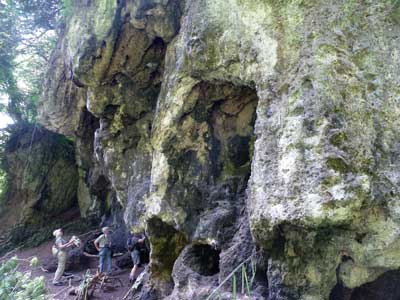
Our initial view of Southstone Rock.
To describe it as a rock does not do it justice. It could more precisely be described as a cliff but one with various huge blocks broken off. The rock itself is full of small holes and cavities - some of these could even be described as small caves. It is mainly light grey in colour although some areas had a pinkish tinge. It is composed of Tufa, formed when water rich in calcium flows through moss growing on the underlying rock. Over time the calcium deposits accumulate and harden while the moss decays, accounting for the numerous holes and cavities within it. More moss continues to grow and the process continues over thousands of years. Carbon dating has proved that the tufa has been forming for 6,700 years. Sometimes small snail shells have been trapped with the tufa, and though we didn’t find any, Rosemary (in true Blue Peter mode) produced one she had found earlier.
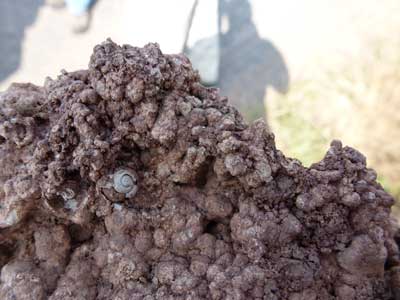
Rosemary’s example of snail shells in the tufa.
We also noted that in certain areas, the rock had a smooth coating of Travertine (chemically the same as tufa), formed when the calcium carbonate had been deposited directly on the tufa rather than on mosses.
After enjoying the Rock and the welcome shade it provided, we progressed uphill with the aim of observing a spring. Here the underlying rocks comprise St Maughan’s Formation sandstone overlying Bishops Frome Limestone. Water seeps through these, dissolving calcium carbonate as it passes through the limestone and then emerges when it reaches the Raglan Mudstone. We found the spring but could only hear it – it was completely covered in vegetation.
On our downward trek we encountered overgrown pathways with many nettles where five of us were glad we had chosen to wear long trousers! Many large trees had fallen recently which blocked our path and could only be passed using rather undignified bodily contortions. Rosemary was relieved that she had described the terrain as difficult when describing the walk in her original e.mail.
At last, we made it to the nearby Church of St Andrew which is almost completely built of tufa. This stone was used because of its lightness in weight and the ease with which it can be carved. The fact that the church is Norman provides proof of the strength and durability of the local rock – Tufa.
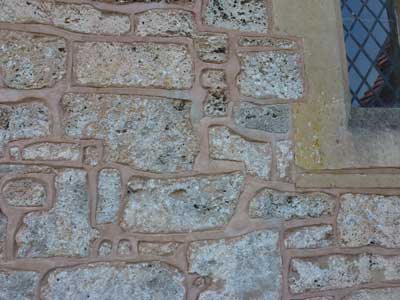
Tufa building stones around the church windows, St. Andrews at Shelsley Walsh.
Finally, the local pub, The Bridge at Stanford, provided welcome refreshment and the opportunity to mull over our morning’s ‘adventure’ with a beer and a sandwich.